
Monroe County Court Records After Arrest
A Monroe County arrest creates a jail and law-enforcement event first. The Monroe County Correctional Facility receives the person, books the commitment, records identity and charge data, and follows Ohio jail intake rules. The sheriff's local government page identifies Sheriff Derek Norman as the Monroe County sheriff, but that booking record is not the final criminal case. After the arrest, the prosecutor reviews reports, complaints, and evidence, then decides what charge to file, amend, pursue, or dismiss. The filed charge opens or continues the court record.
The local path is especially important because Monroe County does not publish an official online jail roster. Custody and booking details belong with the sheriff and jail, while formal court records after a jail arrest belong with Monroe County Court, Common Pleas Court, the Clerk of Courts, and the public CaseLook portal. For the custody side of a booking, use Monroe County jail inmate records. For booking photos, use Monroe County jail mugshots. The court case itself is where the filed charge, bond order, hearing docket, plea, dismissal, or conviction is tracked.
Find Monroe County Court Records
The first online stop for court records after a jail arrest is Monroe County Court CaseLook. CaseLook is useful for a first pass, but its disclaimer is part of the record-search process. Monroe County warns that court computer information can lag behind filings or judicial action, that the delay may be at least twenty-four hours or longer, and that information may be changed without notice. Verified records require a request to the court or an office visit during regular business hours.
The CaseLook disclaimer page shows why a court-record search should not be treated as final proof by itself.
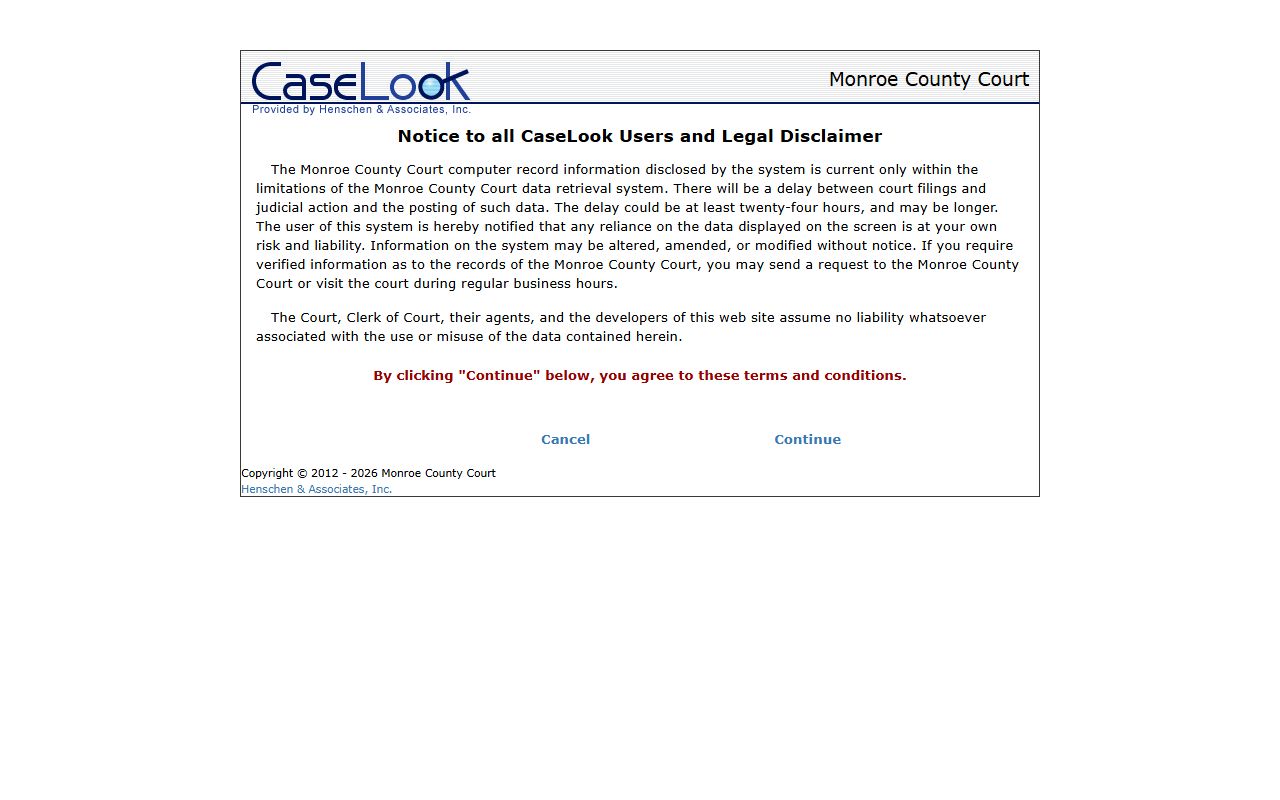
That disclaimer is the reason a missing or stale entry should be checked against the court or clerk when timing, bond, or charge status matters.
- Confirm the person was booked or committed through the sheriff's booking line if custody is the urgent question.
- Identify the likely court. County Court handles many misdemeanor, traffic, and preliminary matters. Common Pleas handles felony criminal cases.
- Open CaseLook, accept the disclaimer, and search the public case information that has been posted.
- If no case appears, allow for posting delay or contact the court or clerk that would hold the filing.
- For felony matters, check Common Pleas records after indictment, information, or transfer because booking charges can differ from filed charges.
Monroe County CaseLook Limits
Research captured the public CaseLook disclaimer, but the search fields beyond the agreement screen were not exposed in text capture. That means the safer content rule is to describe the portal by what Monroe County publishes: the user must accept the disclaimer, public data may lag, and verified records require a court request or office visit. Do not assume a search field exists unless it is visible when the portal is opened.
| CaseLook Item | Type | Required | Notes |
|---|---|---|---|
| Continue or agreement | Button or link | Yes | The disclaimer must be accepted before search access. |
| Search fields after Continue | Not captured | Unknown | The text capture did not expose the form, so field names should not be inferred. |
| Verified record request | Court or office request | Needed for certified facts | CaseLook itself warns that verified information requires a court request or office visit. |
CaseLook can help locate a public case, but it is not a same-minute jail roster and not a booking-photo database. It should be paired with the correct court office when the question is whether a charge was filed, changed, dismissed, or set for hearing.
Monroe County Court Contacts
Court records after a Monroe County jail arrest are split by case type. The Monroe County Court is the likely contact for many misdemeanor, traffic, and preliminary criminal matters. The Monroe County Common Pleas Court handles felony criminal cases. The Clerk of Courts is the records office for filed case material and certified copies.
Monroe County Court
101 N. Main St., Room 12
Woodsfield, OH 43793
(740) 472-5181
Monday-Friday, 8:00 AM-4:00 PM
Common Pleas Court
101 N. Main St., Room 33
Woodsfield, OH 43793
(740) 472-0841
Felony criminal case court
Clerk of Courts
101 N. Main St., Room 26
Woodsfield, OH 43793
(740) 472-0761
Clerkofcourts@monroecountyohio.com
The court and clerk addresses are at the Woodsfield courthouse, not the jail on Moore Ridge Road. That local split matters. Jail booking, inmate account, visitation, and current custody questions route to the sheriff's facility. Filed court records, docket entries, certified copies, and case status route to the courthouse offices.
Monroe County Charging Documents
The charging document is the point where the arrest becomes a formal court case. A complaint may start the case soon after arrest. A prosecutor-filed information may be used in eligible felony settings. A grand-jury indictment is common in serious felony matters that move to Common Pleas Court. Monroe County court records after a jail arrest should be read with that sequence in mind because the first booking label can be broader or less precise than the filed charge.
| Document | Who Uses It | Common Role | Why It Matters |
|---|---|---|---|
| Complaint | Officer or prosecutor | Often the first filed accusation | May begin a County Court matter or preliminary felony path. |
| Information | Prosecutor | Formal prosecutor-filed felony charge in eligible cases | Can replace or refine the initial arrest or complaint wording. |
| Indictment | Grand jury | Formal felony charging document | Moves the charge into Common Pleas Court for felony prosecution. |
The Monroe County Prosecutor's Office is led by James L. Peters at 101 N. Main St. in Woodsfield. The office evaluates reports and referrals after jail arrest, then decides what criminal charge to pursue. Victim-witness questions may route there, but defense advice, court deadlines, and certified copies do not.
Monroe County Charge Status
Charge status is the reason a court record can look different from a booking record. A person may be arrested on one suspected offense, booked on a short label, and later charged with a more exact offense. The prosecutor may amend or reduce a count. A court may dismiss a count. A plea or verdict may create a conviction on one charge while another count is dismissed.
| Status | Plain Meaning | Record Caution |
|---|---|---|
| Pending | The charge has not reached a final disposition. | Check later entries for plea, trial, dismissal, or amended charge. |
| Amended | The charge text, code, degree, or count was changed. | Compare the original filing with the newest docket entry. |
| Reduced | A lesser charge replaced a more serious one. | Do not describe the original charge as the conviction. |
| Dismissed or nolle | The count is no longer being actively prosecuted. | Other counts in the same case may still remain pending. |
| Conviction | Guilt was found by plea or verdict. | Use the disposition, sentence, and judgment entry for the final result. |
Bond After Monroe County Arrest
Bond is part of the court process, not merely a jail payment screen. ORC 2937.011 directs Ohio courts to use the least restrictive release conditions that reasonably assure court appearance, public and person safety, and non-obstruction of justice. It also requires misdemeanor bail schedules, including traffic offenses, to help speed release before an initial appearance. Monroe County-specific bond-payment methods were not published in the sheriff jail material reviewed, so the correct office depends on the filed case and current custody status.
| Bond Type | How It Works | Monroe County Checkpoint |
|---|---|---|
| Personal recognizance | Release based on a written promise and court conditions. | Confirm conditions with the court that set release. |
| Cash bond | Money is paid to secure appearance. | Ask the court or booking line whether it is jail-postable. |
| Surety bond | A licensed bail agent or surety backs the bond. | Confirm case number, court, amount, and restrictions first. |
| No-bond hold | Release is blocked by court order or another agency hold. | Ask about probation, parole, other-county, federal, or immigration holds. |
Important: Jail account deposits are commissary funds, not bond payments, unless a court or jail officer specifically says otherwise.
Warrants and Monroe County Arrest
No official Monroe County sheriff active-warrant search page was located in the research. CaseLook may show case-related warrant activity, such as a bench warrant or failure-to-appear entry, when it has been posted. The disclaimer still applies, so verified warrant status should come from the issuing court, the Clerk of Courts, or the Sheriff's Office. The sheriff units page describes high-risk warrant service as an operational function, but that is not a public warrant list.
- Arrest warrant
- A judge-authorized warrant based on a case, complaint, or probable-cause showing.
- Bench warrant
- A warrant issued by a judge, often for failure to appear or a court-order violation.
- Search warrant
- A warrant to search a place, person, or property. It is not a custody lookup record.
- Detainer or holder
- A request or authority from another agency that can keep a person in custody.
For state supervision issues, Ohio DRC Offender Search includes status categories such as Violators at Large and APA supervision. Federal warrants are not in Monroe County systems and should be checked through federal court or U.S. Marshals channels.
Charges Versus Convictions
A charge is an accusation. A conviction is a final legal result after a plea or verdict. That distinction is crucial for court records after a jail arrest because a person can be arrested and charged without being convicted. A dismissed charge should not be described as guilt. An amended charge should not be treated as if the first booking label was the final court result.
| Issue | Charge | Conviction |
|---|---|---|
| Stage | Filed accusation after arrest or review | Final guilt by plea or verdict |
| Proof level | Based on probable cause and charging decision | Requires plea or proof beyond a reasonable doubt |
| Can change | May be amended, reduced, added, or dismissed | Changed only by later court action, appeal, or record relief |
| How to verify | Read the charging document and docket entries | Read the judgment entry and sentence record |
Sealed and Expunged Records
ORC 2953.32 covers sealing or expungement of eligible conviction records or bail forfeitures, subject to exceptions, waiting periods, hearings, notice to the prosecutor, and other limits. A sealed record is generally hidden from public view. Expungement is stronger and may treat the record as destroyed or erased for many purposes. Eligibility is case-specific, so the court record and final disposition matter.
| Relief Type | Public Visibility | Practical Effect |
|---|---|---|
| Sealed | Removed from ordinary public access | Some authorized agencies may still have limited access. |
| Expunged | Treated more like destruction or erasure where allowed | Broader relief, but only when Ohio law permits it. |
| Not eligible | Remains public unless another law restricts it | Check the exact offense, disposition, waiting period, and exception list. |
Juvenile matters, sealed cases, some law-enforcement investigatory records, and records affected by privacy exemptions may not be fully visible through public search. Public court access in Monroe County also depends on the court that holds the file and whether the record has been posted or restricted.
Record Use Limits
Casual court lookup and regulated background screening are not the same task. Court records after a jail arrest can help a person understand a public case path, but they may be incomplete, delayed, amended, sealed, or expunged. Any use for credit, employment, housing, insurance, tenant screening, or another FCRA-covered decision requires a proper consumer-reporting process, not a general web lookup.
Important: Verify court records with the issuing court or clerk before relying on charge, bond, warrant, or disposition information.